
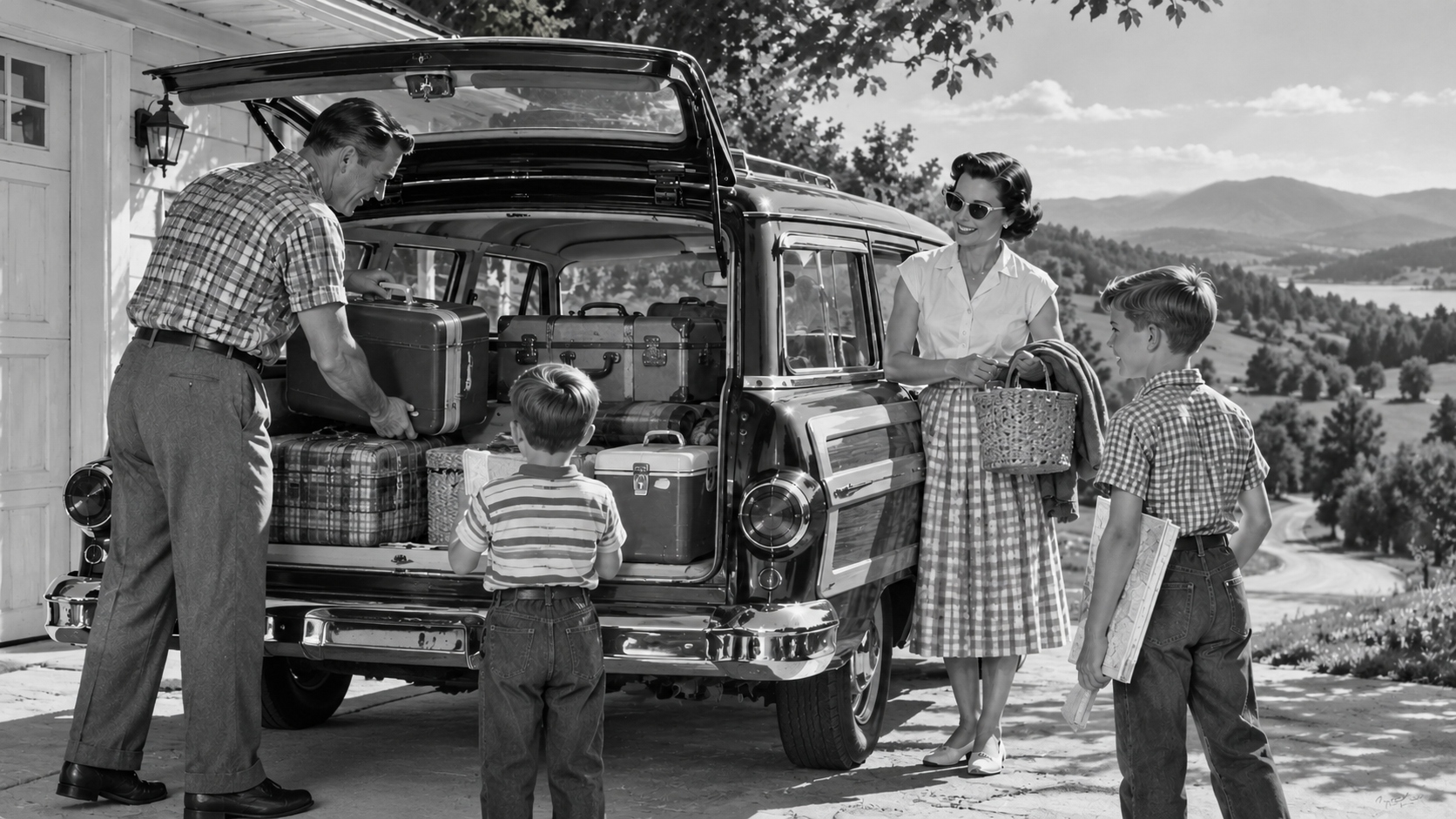
There was a time when getting somewhere was part of the story.
Before the interstate highway system turned long-distance travel into a calculation of exits, miles and arrival times, the road passed through the places in between. It slowed for towns. It crossed railroad tracks. It ran past filling stations, diners, motels, churches and courthouse squares.
If you were traveling south, you didn't simply cross a state. You passed through it.
For Alvin and Ann Rasmussen and their five boys, those roads were more than a way to get from one place to another. For a number of years, they were part of the family's life.
The boys grew up making music together. Alvin played piano, and the family developed an unusual traveling program built around singing and an assortment of instruments. They went from church to church, town to town, carrying the family, their instruments and everything else they needed with them.
A small newspaper notice from 1954 provides one surviving glimpse of that life.
The Medford Mail Tribune in Oregon announced that "The Rasmussen family of Oviedo, Fla." would present a musical service at the Medford Assembly of God. Alvin was named along with four of the boys—Rowlyn, Ralyn, Don and Paul—and the paper listed some of the instruments they would play: sleigh bells, cow bells, marimba, silver saw and piano.
It is only a few lines in an old newspaper.
But think about what had to happen before those few lines could be printed.
The family had to get to Medford.
There were no interstate highways as we know them today. The great Interstate Highway System would not be authorized until 1956. A family traveling across the country in 1954 followed the older U.S. highways and state roads, passing directly through communities that later highways would bypass.
Mile after mile. Town after town.
The boys rode together. The instruments traveled with them. There would be another church ahead, another congregation, another place to unload and set up.
Then they would pack everything again and continue down the road.
Ralyn later remembered those traveling years as beginning when he, his twin brother Rowlyn and their older brother Marlyn were still children. Eventually all five boys were part of the family. In 1954, Alvin and Ann took the youngest four to Brazil, beginning another chapter of the family's life on the road.
Family memories fill in things that newspaper notices never could.
There were rural churches and families who took the travelers into their homes. There were meals provided by people who did not necessarily have much themselves. There was at least one occasion, remembered years later, when the meal available to the traveling boys consisted essentially of bananas.
Those aren't the sorts of things that make the newspaper.
But they are the things a family remembers.
Perhaps that's part of what we've lost as the roads became better.
The interstate is an extraordinary piece of engineering. It allows us to cover in hours distances that once consumed most of a day. We can travel hundreds of miles while barely slowing down.
But efficiency has a price.
The interstate goes around.
The old road went through.
It went past the church where a traveling family might be expected on Sunday afternoon. It passed the café where everyone stopped for lunch. It crossed the main street where somebody might notice an unfamiliar station wagon loaded with children and musical instruments.
The road introduced you to places because it gave you no choice but to see them.
Many of those roads are still there.
They have different names now: Business Route, Old Highway, County Road. Sometimes the pavement narrows. Sometimes a motel sign survives beside a building that hasn't rented a room in decades. A filling station has become an antique store. A restaurant is boarded up. The old highway crosses the interstate, disappears for a few miles and then emerges again on the other side.
And every so often there is still a church beside it.
I sometimes wonder how many of those churches once heard the Rasmussen boys.
Most of those performances are gone now. There was no video camera recording them. No one was uploading the evening's music for people to watch seventy years later.
What remains are memories, a few family stories and occasional scraps of evidence like that 1954 newspaper clipping from Medford.
That's enough to establish that they were there.
But the road tells part of the story too.
When I take an old highway instead of the interstate, I find myself thinking about the people who traveled it when it wasn't the scenic alternative. It was simply the road.
They weren't taking the slow route.
There wasn't a faster one.
For Alvin, Ann and the boys, somewhere down that road was another church, another congregation and another evening of music.
Today we tend to measure a good road by how quickly it allows us to pass through a place.
The old road asked something different.
It asked us to notice where we were.